
What does getting recommended by ChatGPT depend on for a local business?
Getting recommended by ChatGPT depends on whether its web search can find and verify what you say about yourself. ChatGPT works from search partners, mainly Microsoft, so you need a crawlable website, a Bing presence, clear service and location details, and reviews on other sites too.
ChatGPT doesn’t know you, and it never will. It only knows what it finds about you on the web. If a client asks it where to get a good gel manicure in their city and you’re not in the answer, it’s not about your quality. The machine simply couldn’t verify that you exist.
This isn’t a future problem. According to SparkToro data, 68% of US Google searches ended without a click in early 2026, meaning the answer increasingly happens on the results page or in an AI summary. If you’re not in that answer, your website often doesn’t even get opened.
How ChatGPT searches for a local provider
GEO (generative engine optimization) means structuring your content so AI-powered search tools can find it, understand it, and cite it. Unlike classic SEO, you’re not competing among ten blue links, you’re competing to be one of the three to five sources behind the answer.
According to OpenAI’s help center, ChatGPT search works with search partners: it rewrites your question into one or more targeted queries and sends them to those partners. It names Microsoft as a partner. It also says a website must allow the crawler called OAI-SearchBot, or it can’t appear in results, and that placement isn’t guaranteed.
Damian Rollison, an analyst at SOCi, traced what happens during a local query in detail for Search Engine Land. In his observation, ChatGPT runs a Bing search, picks a few of the top 20 to 30 results, and ends up relying on 3 to 5 sources that are verifiable, not paywalled, and show ratings. That can be the business’s own site, Facebook, Yelp, a city guide, or a Reddit thread. It doesn’t see Google Business Profile directly.
The analysis is partly based on questioning ChatGPT itself, and the system keeps changing. The core point is stable, though: ChatGPT doesn’t look at your Google ranking, it looks at what it can find about you on the web, mostly through Bing’s eyes.
Why ChatGPT can’t find you
Most service providers fail on the same five points. The table shows the mistake and what it looks like through the machine’s eyes.
| Mistake | What ChatGPT sees |
|---|---|
| No website of your own, just Instagram | Little crawlable, quotable text about you |
| Your site blocks AI crawlers | According to OpenAI, it can’t appear in results |
| Your site doesn’t say what, where, and for whom | It can’t connect the question (“nail tech in [city]”) to you |
| Prices and services only in images | The text in an image may not get read |
| No reviews on other sites | No third party confirms what you claim |
A price list posted as an image is a problem for Google and for clients too, not just ChatGPT. I wrote about it separately: price list as an image.
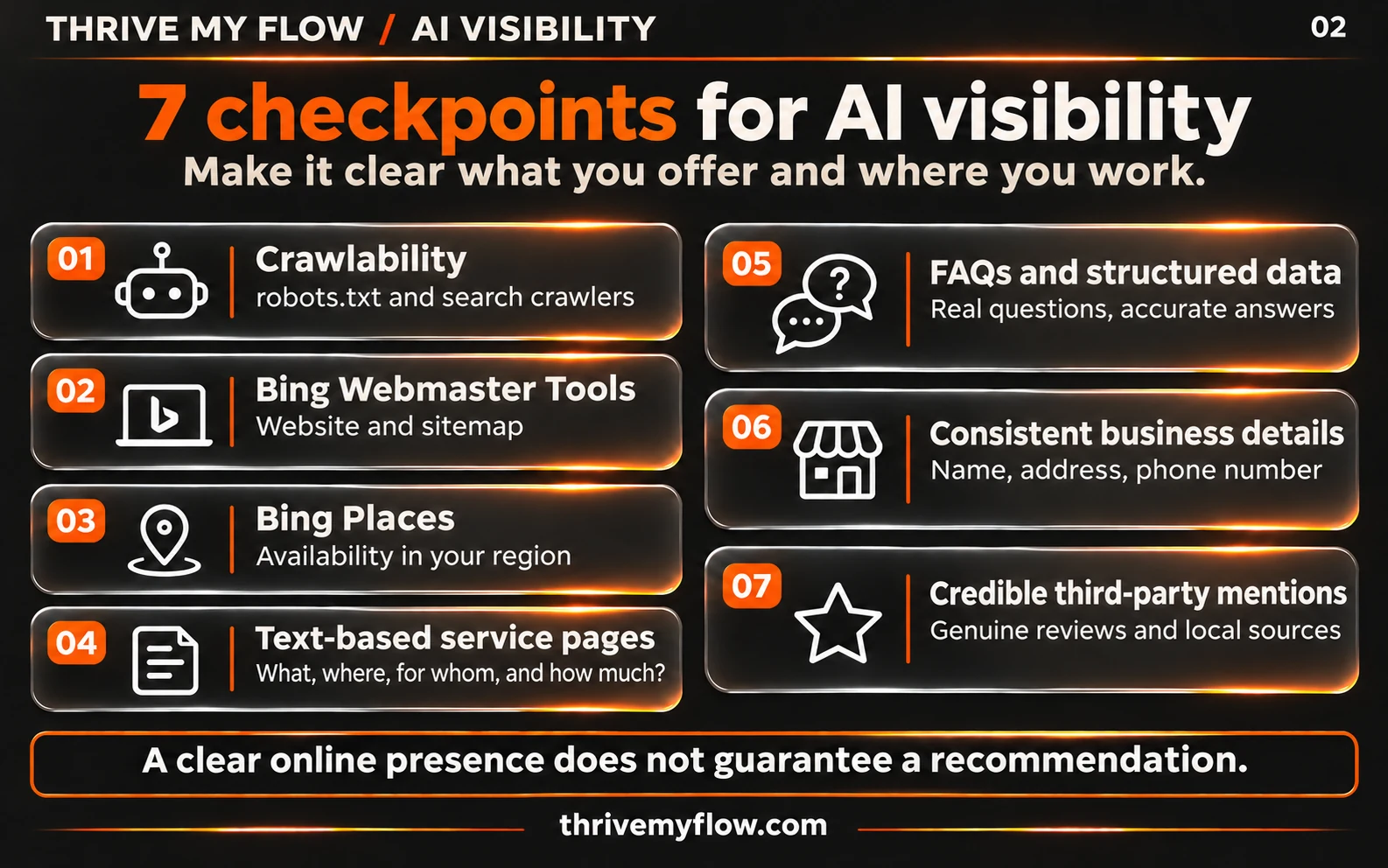
Five-minute test: do you show up in ChatGPT?
- Open ChatGPT logged out or in a private window, so your past conversations don’t skew the result.
- Ask the way a client would: “Where can I get a good gel manicure in [your city]?” Use your own service and city.
- Check the sources under the answer. Which sites does it cite, and are you among them?
- Run the same search on Bing. If you’re not in the top 20 results there, you won’t be in ChatGPT either.
ChatGPT’s answers vary by question and by session, so don’t draw a final conclusion from one try. Three different phrasings already show the direction.
Getting recommended by ChatGPT: 7 steps
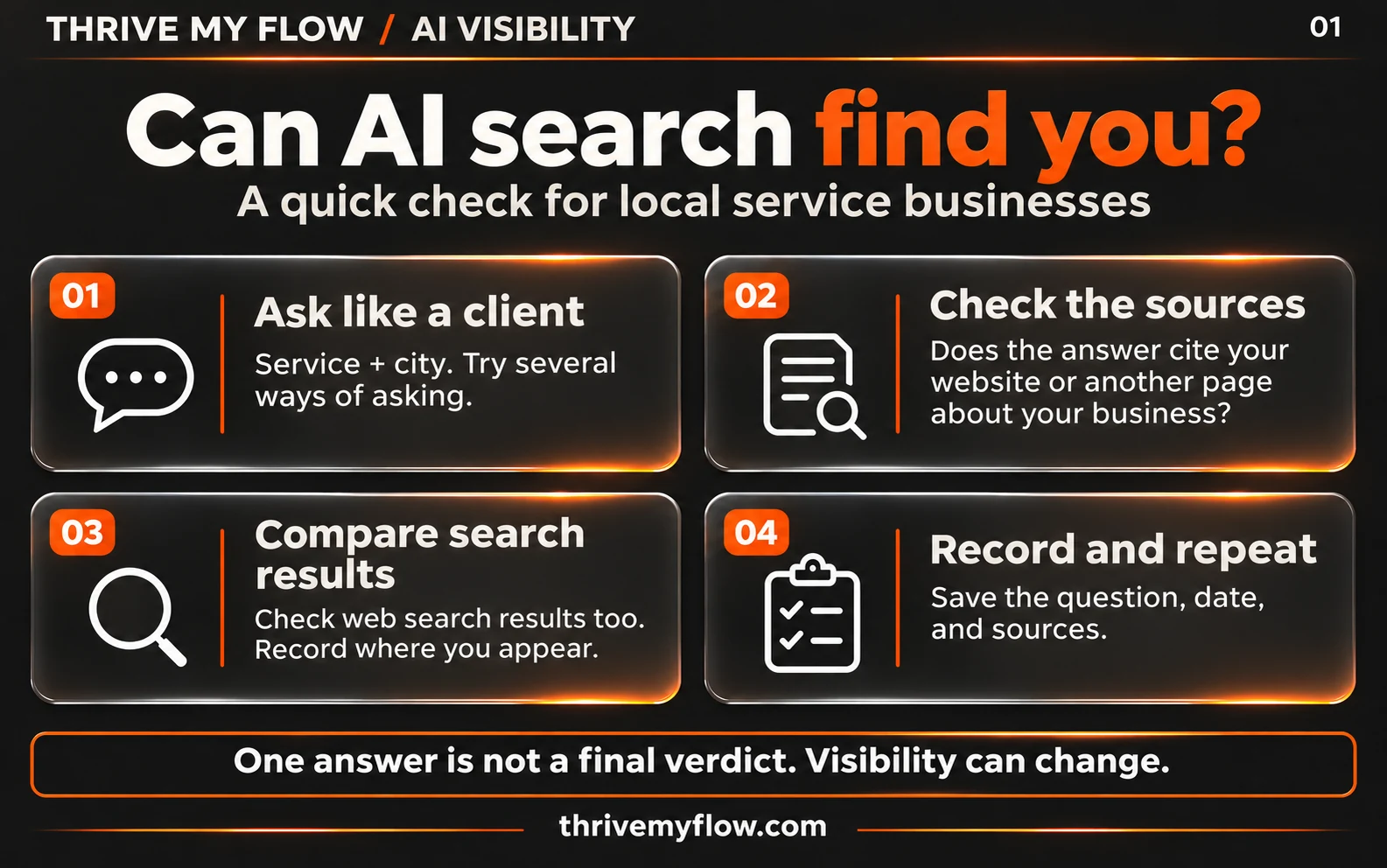
- Let AI crawlers in. Open yourdomain/robots.txt. If it contains
User-agent: OAI-SearchBotwithDisallow: /below it, ChatGPT won’t search your site. Check Bingbot the same way. In WordPress, you can fix it in your SEO plugin’s robots.txt editor (Rank Math, for example). - Sign up for Bing Webmaster Tools. Add your site and submit your sitemap. If you have Google Search Console, you can import from there.
- Check Bing Places. If it’s available in your region, create or claim your business listing. According to the Rollison analysis, ChatGPT doesn’t see it directly, but it affects Bing’s organic results.
- Say what, where, and for whom, in text. Every service needs its own page or section: what the service is, which city, how much it costs, how long it takes, who it’s for. As text, not images.
- Write an FAQ with your clients’ real questions. The ones you always get on Messenger. Add FAQPage and LocalBusiness structured data, which tells machines clearly what is what.
- Use the same name, address, and phone number everywhere. Website, Facebook, Instagram, Google Business Profile, Bing Places. If it’s “Kate Nails” in one place and “Katherine Smith LLC” in another, the machine may see two different businesses.
- Collect reviews and mentions on other sites. Facebook reviews, a local magazine, a chamber of commerce directory, a “best of the city” article. These are the third parties that confirm what you say about yourself.
What not to buy, and what not to do
- A “guaranteed ChatGPT placement” package. OpenAI itself says placement isn’t guaranteed. Anyone guaranteeing it is promising something that isn’t in their hands.
- Keyword stuffing. Text like “nail tech [city] best nail tech nail tech near me” is unreadable for clients and gives the machine no new information.
- Mass-produced, unchecked AI articles. If every provider generates the same generic text, your site won’t be any more quotable than the rest.
- Fake reviews. Across the EU, publishing or commissioning fake consumer reviews has been explicitly listed as an unfair commercial practice since the Omnibus Directive took effect in 2022.
The honest limit: if 90% of your clients come through referrals and your calendar is full, this work pays off less for you right now. But if you want new clients from a new neighborhood or for a new service, it puts you where people are already asking.
FAQ
Do I have to pay to get recommended by ChatGPT?
No. OpenAI’s help center doesn’t mention paid placement in search results. To appear, your site must be crawlable and look like a relevant result based on web sources. If someone promises guaranteed placement for money, ask what they base it on.
Does Google Business Profile matter for ChatGPT?
Not directly, according to the Search Engine Land analysis, because ChatGPT has no access to Google’s data. You still need a good profile for Google, and if other pages reference it, it can show up indirectly. Manage both, and Bing Places too.
How do I check whether my site allows AI crawlers?
Type your domain followed by /robots.txt into your browser. If you see Disallow: / under OAI-SearchBot or Bingbot, they’re blocked. If you’re not sure what you’re looking at, send the address to a professional, it takes five minutes to check.
Is an Instagram profile enough?
Rarely. Most Instagram content is images and video, with little crawlable, quotable text about your prices, location, and services. A simple website of your own states these clearly and connects your profiles.
How long until I show up in ChatGPT?
There’s no reliable number for this, and placement isn’t guaranteed. Crawling, Bing indexing, and collecting reviews take weeks to months. Run the same five-minute test once a month and note whether anything changed.
What is GEO?
GEO stands for generative engine optimization: structuring content so AI-powered search tools can find it, understand it, and cite it as a source. For a small business, in practice, that means clear text-based service pages, an FAQ, and consistent business details.
If I block AI crawlers, am I protecting my content?
Partly, but it comes at a cost: according to OpenAI, if OAI-SearchBot can’t crawl your site, you can’t appear in ChatGPT’s search results. For a service provider, being found usually matters more than keeping your service description from being read.
Next step
Not sure what ChatGPT and Bing see when they look at you? Send me your website, and in a 10-minute video I’ll show you what’s missing for the machine to find and verify you. Get your free review.
Sources
- OpenAI Help Center: Searching the web with ChatGPT. help.openai.com
- Damian Rollison: How does ChatGPT conduct local searches?, Search Engine Land. searchengineland.com
- SparkToro data on zero-click searches in early 2026, TechWyse summary. techwyse.com
- Directive (EU) 2019/2161 (Omnibus Directive). eur-lex.europa.eu